 The Expert Corner: The Island's Wine with Alderlea Vineyards
Actions
Introductions
ZAC: I'm Zac Brown. Julie [Powell] and I own Alderlea, but we're also the only two full-time employees here. Us and the dog, Vino.
JULIE: On our business cards, it's proprietor, winemaker, but basically we're the owner-operators, winemakers, tractor drivers, dog walkers. So, kind of everything, really.
How did Alderlea come to be?
JULIE: Alderlea is one of the oldest vineyards and wineries on the Island. It started in the early ‘90s by our predecessors, Roger and Nancy Dosman, as a second career for them, and then it became our second career in 2017. We're going into our ninth harvest, and we almost know what we're doing now.
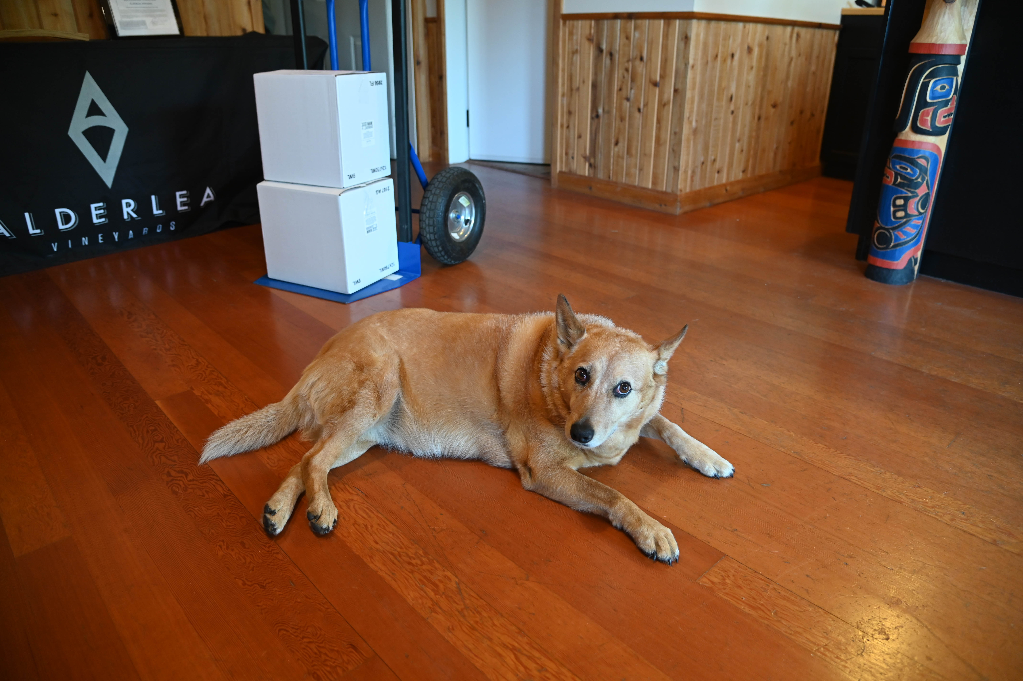
The beloved winery dog, Vino.
Where did the passion for wine come from?
ZAC: I went to the Czech Republic in the early '90s, and I learned to make wine in a small winery there. It was what we would call "natural winemaking”, but I learned it from a guy who had a PhD in chemistry. He ran the local drinking water plant, and the winery was a family thing. So, I got to learn traditional old school winemaking from a guy who had a solid foundation in the hard sciences, and I think that still influences how we make our wine today.
I see winemaking as the ultimate Renaissance craft. You have to have a solid foundation in the sciences. Often, factory-made wines that are technically correct lack a little artistic flair, and they can be kind of boring. Then, if you get wines that are too artisanal, without a respect for the hard sciences, they can have microbial flaws or funky flavours. If you have one foot in the science and one foot in the artistic side of things, you end up making truly special wines.
What is garagiste winemaking, and how did it lead to running your own winery?
ZAC: When Julie and I got married, 20 years ago, I was making wine in the garage, and we were living in Montreal, and I fell in with this hardcore garagistes wine club.
Garagiste winemaking is a branch of home winemaking where the wine quality is very high. You have a group of people who are pushing each other to make high-quality wines, and you're sourcing grapes from the best areas you can, but you're making that on a really small scale. So, there was a group of nerds making wine in garages all across southern Quebec, and we would import grapes from California, or we even brought grapes from Chile one year.
When we moved to Vancouver, Julie and I kept making wine in the garage, and we were sourcing grapes mostly from Washington State. In 2015, we were making a thousand bottles of wine a year, and it got to the point of the hobby that I either needed to do it professionally or never make wine again.
We went from making wine in the garage, and then this year, at the All Canadian Wine Championships, we won more medals than any other winery, which is like Lithuania winning the Winter Olympics.
What was it like leaving the stability of corporate jobs to pursue this dream?
JULIE: We’d gotten to a place in our corporate jobs where we felt like a lot of our best work was behind us. We’d had interesting careers, travelled, had overseas assignments, met some interesting people, done great work, but we were looking down the barrel like, “Oh, I don't know if I want to do another 10 or 20 years of this.”
We did bring a lot of skills with us that we didn't think we were necessarily conscious of. When you work in a major corporation for a lot of years, you understand how to read a financial statement, manage a budget and a team, source stuff, work with suppliers and vendors, and all of those things that we didn't even have to think about.
What was the process like to find Alderlea? How did you know it was the perfect fit?
JULIE: A lot of times, [wineries] are for sale for years. It seems romantic, but it's a heck of a lot of work.
Part of the reason why we didn't leap blindly was because we knew how big it was. We went into it with our eyes wide open, knowing what it would take to be successful. So, we were at a point where we were like, “Let's give it a try. What could go wrong?”
We finally found Alderlea almost 10 years into that search. It was the end of October when we first came to see the property. Everything was yellow, the sun was shining, and we spent three and a half hours with Roger and Nancy touring the property. We drove out of the driveway – hadn't even made it to the neighbour’s driveway – when I was like, “Oh my God, that's the place!”
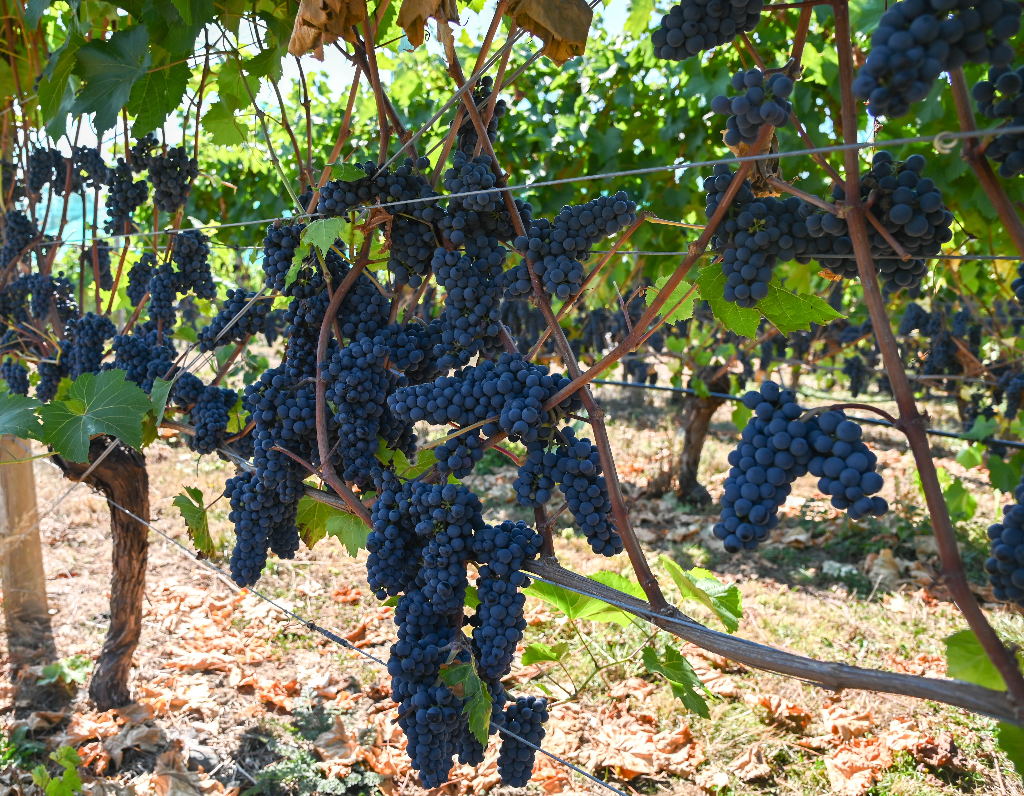
Grapes nearly ready to be harvested.
What was the experience like moving from garage wine to running a vineyard?
JULIE: We came into this, and we didn't know what we didn't know. We Forrest Gump-ed our way through so much of it and learned. But we were open to learning, and we were fortunate that on Vancouver Island, there’s a growers' association.
Zac, being the nerd that he is, not only did he have some mastery in winemaking, but he immersed himself in everything there was to know about grape growing and regenerative farming, sustainability, organics, and nutrients. We did a lot of testing to understand the baseline of the vineyard.
Now that you’ve overcome some of the beginning-stage hurdles, what are your biggest challenges currently?
JULIE: One of our biggest challenges has always been any kind of work-life balance, because we are the business, and when you live where you work, you work all the time.
That is the one thing we've said in recent years - because we've kind of been going nonstop - that we need to find ways to concretely build that balance in so that we are able to continue. We're so fortunate to be able to do what we're doing. You also just want to enjoy it. You don't want it to pass you by because you're constantly working.
How have you grown and set Alderlea apart in a very saturated market while remaining rooted in your values?
ZAC: We had a finite size in mind from the start. We wanted to be about 3,500 cases to 4,000 cases, which is where we are. Any bigger than that and your costs go way up, but also, could it cause us to lose focus?
People say to us, "Oh, you guys should have a restaurant, or you should have a picnic area”. And it's like, we're growing good grapes and we're making great wine. Full stop. We do all of this, but there's no gift shop. There's no merch, there's no distractions.
JULIE: We're as big as we want to be, and we've managed to get there within the last eight years. Obviously, there's been a lot of hard work to get there, but we started with a pretty clear vision of what we needed to make it successful.
ZAC: Island wine for island people was our tagline ads, but it was also our vision as well. We always wanted to be the locals' favourite winery, because locals are buying your wine in January, they're buying your wine for family, or 'cause they had a crappy Thursday, or to celebrate something wonderful.
How has being life partners factored into your business?
JULIE: We used to joke coming into this that we had been married for 12 years, but together for 8, because we spent so much time apart. A former colleague was like, "How's that gonna be with you guys? You’ve spent so much time apart if you're working side by side, like maybe it'll be the end of your relationship”. I'm like, “No, no, no, we got this.”
We both bring very different skill sets to the mix, and I think that's a large part of why we've been able to be so successful. We had this diverse set of skills so that we could partition things and say, “Well, you're the head person on this, but I'm here to help you with this as well.”
ZAC: Even on a day-to-day, we're not in each other's pockets. I could be in the vineyard all day long, and we see each other at dinner time. I think we both communicate very well, and I don't think it would work if we didn't.
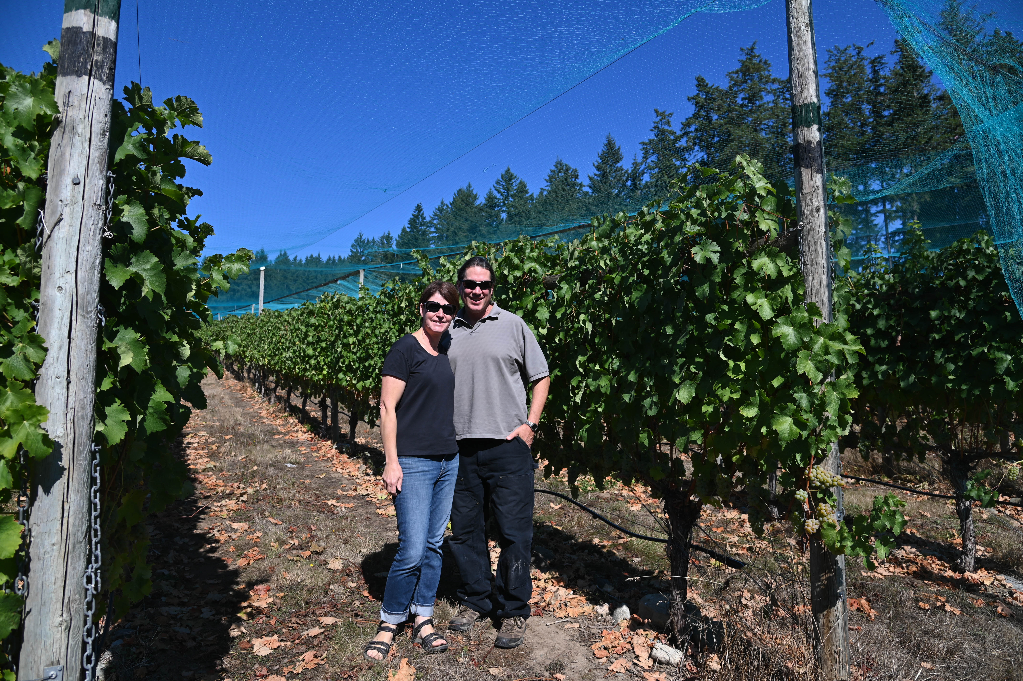
Julie Powell and Zac Brown amongst the vines at Alderlea.
We’ve seen some massive changes in the liquor industry as a whole recently. How do you manage flexibility during unpredictable times?
JULIE: The jobs that we had previously, there was so much change happening all the time, so we really had to adjust and be able to make changes on the fly. Situations change, whether it's “this was the grape, we planned to harvest today, but we can't for this reason,” or “this was the wine we thought we were going to make, but we can’t because those grapes aren't going to be suitable.” Being able to make decisions quickly and come to an agreement as to what the plan of action needs to be.
ZAC: That's like a legacy of our former corporate careers. I worked in environmental health and safety, so there's always a crisis to deal with. Julie worked in human resources; there's always a people problem to deal with.
With recent changes, how have consumer habits shifted?
ZAC: Within the wine space, we're seeing people buy less wine overall, but they're spending more per bottle, and they're looking for higher qualities. So, while they may not be buying a case, they might be buying two bottles a month, but they're buying local, high-quality wines, and I think that's what we're seeing in our own business.
JULIE: We really have built the brand around the quality, the local side of it, the dog – I'm only half joking on that. She is a celebrity – but seriously, it’s making that connection. People want to support local.
ZAC: I think we're going to see wine return to its roots. The whole “wine as an industry”, rather than wine as a local product, is a fairly recent change. Drinking local wine with local food with your friends and people you care about – I don't think that's going away.
What are some of the best defences against environmental volatility? How do you promote sustainability through your vineyard and winemaking?
JULIE: Keep your vines as healthy as you can, make sure they've got the nutrients, make sure they've got what they need. Obviously, all kinds of extremes can happen as we've seen in the Okanagan with fires and freezes, but focusing on what we can control and strengthening our position as farmers, winemakers, and business operators.
ZAC: I think both the climate change piece and the customer piece, what links those two things together is sustainable farming. You can look around and see that this is a sustainably farmed vineyard.
Outside of farming and winemaking, what role has sustainability played in other areas of Alderlea?
JULIE: You want to employ locally as much as possible. That's sustainable in that it’s supporting our own community. That really comes back to our values, and frankly, it's just good business.
ZAC: We have a mix of new immigrants, single moms, semi-retired people, and students, so we offer opportunities to a broad spectrum of people, but they're from here. They're learning skills, and then those skills stay in the community. If I haven't got enough work for somebody, but this vineyard or this winery is looking for people, we can send people that way. It keeps those skills in the community and keeps the workforce stable and employed. Eventually, it grows a community.
How important has community been in your journey?
ZAC: We started here nine years ago as the newbies. Big wide eyes and didn't know what we didn't know, and now we're in a position where we've been focused on giving back to our industry, particularly here on the island. I spent four years on the Wine Islands Growers Association board, and Julie is president of the Cowichan Valley Wineries Society, so for a little winery like us, it’s being able to give back and to keep that community going.
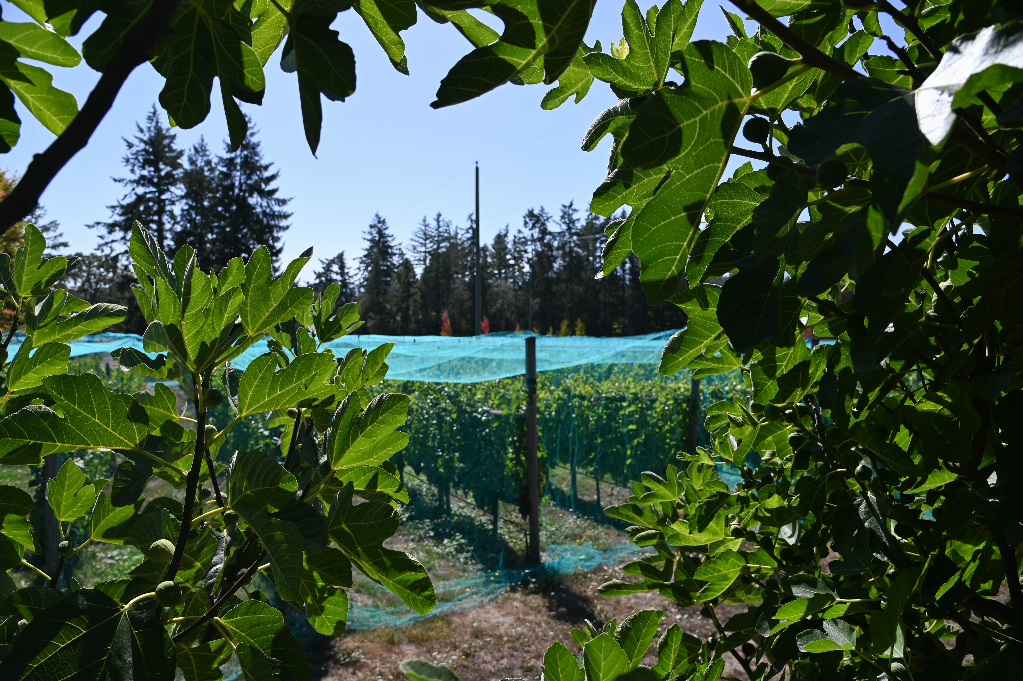
A glimpse at Alderlea’s vines covered by bird nets to help protect the grapes.
How do you keep things interesting, both for yourselves and for customers?
ZAC: We have our main wines, which are available in most of the liquor stores, and then we have side project wines. Julie makes a wine called Valerie, and that's about 110 cases, and it's a tasting room only.
So, I think it's maintaining the quality in our best-known wines and keeping it exciting for our wine club and people who come to the tasting room with these little 100-case projects as well.
What are your favourite wines that you make?
ZAC: That's like asking which one of our children is my favourite… but the Pinot Gris. We make a Ramato (meaning “copper” in Italian) style, which has some skin contact, so it's a little different than your typical Pinot Gris. You do 24 hours of skin contact, so it picks up more body, more flavour, more interesting notes, and then you press and ferment it. People love it, and we can't make enough of that one.
Julie's Valerie has won two double golds, three golds and a silver at the Canadian Championships, which is pretty amazing, and it's probably the only Ortega/Viognier blend in the world.
JULIE: Valerie came about by necessity. It was before the new vineyard had been planted down the street, and we had a supply problem. We didn't have a lot left in the tasting room, and you can't be sold out of white wine in your tasting room in July.
So, it was an opportunity to do an interesting blend where you've got a great Ortega, which is super delicate and light, and then you've got Viognier, which has got a real personality, and that's the right combination.
It's a wine that I named after my late mom. We were just going to make 100 cases, and figure something else out next year, but then Valerie goes off to the All Canadians, wins the gold medal, and so we've produced 7 vintages now.
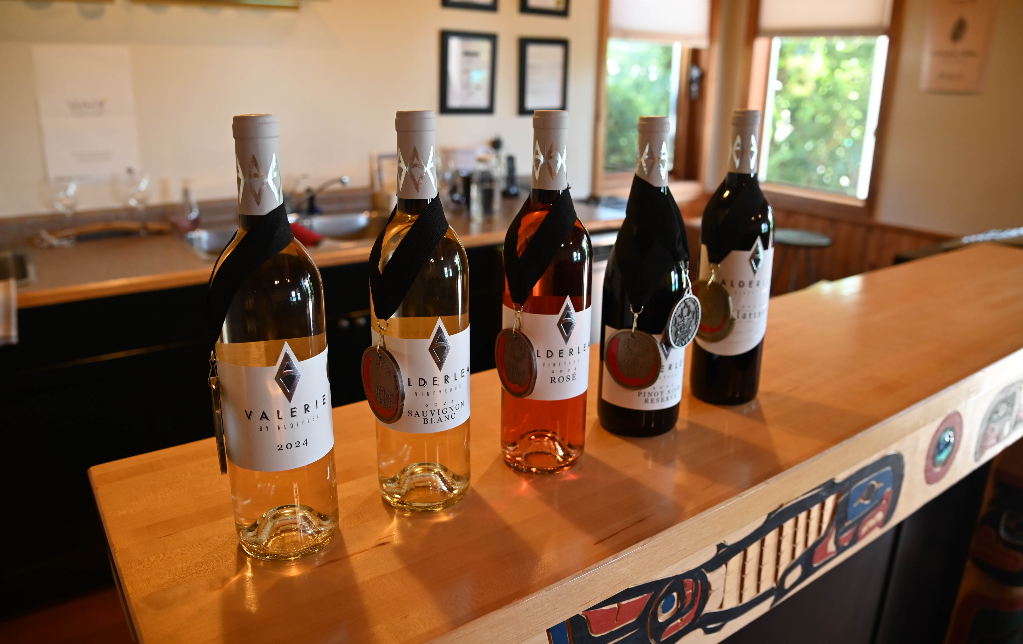
A selection of Alderlea wines with their medals from the All Canadian Wine Championships.
How do you feel about the perceived exclusivity around wine and the industry itself?
JULIE: At the end of the day, it’s just wine. Sometimes people get overly romantic about our industry, or worse, they get intimidated by it. You see this a lot in the tasting room, people coming in and they're a bit nervous. If you know a little bit, that's great; if you know nothing, that's great. The fact that you're interested enough in wine that you want to taste it; that's amazing.
ZAC: I think for us as small producers, the thing that I enjoy is making wine accessible and not intimidating, because we're not that kind of people. Our sessions [at Alderlea] are always somewhat educational, and they can ask us any questions. There are no dumb questions in here, and I think that's important.
We say to people all the time, just be willing to try new things. Don't be one of those people who's like, "I only drink Chardonnay," …
JULIE: …or “I hate Merlot. I never drink Merlot.” It's like, but there's so much Merlot in the world! There are so many different wine regions and winemaking styles. Keep trying it because maybe you had one you didn't like, but that doesn't mean there isn't a Merlot out there for you.
As you get older, your palate changes, things change. Even pairings, it might be a wine you wouldn't necessarily buy a bottle of, but in the right pairing, it can be like, "Wow, this is great, and a new experience”. It's being open but not being intimidated.
You don't have to be an expert. I'm still learning every day.
-------------------------------------------------------------------------------------------------------------------------------
Alderlea Vineyards is located at 1751 Stamps Rd in the beautiful Cowichan Valley. Their tasting room is open daily by appointment.
A selection of Alderlea products can be found at Mid Island Liquor locations across the Island.
Learn more:
Website: alderlea.ca
Facebook: Alderlea Vineyard
Instagram: @alderleavineyards
