 The Expert Corner: In The Spirit with Arbutus Distillery
Actions
Introduction
MIKE: Mike Pizzitelli, I'm the owner, distiller, janitor, everything. Lion tamer. Whatever needs to be done.
How did Arbutus come to be?
It started off as a hobby, both brewing beer and distilling. I was in school for cell biology and science - I did that for a long time - and then eventually I went to Scotland and did a master's in brewing and distilling.
After working as a craft brewer, I decided I liked the blend of culinary art and food science that came with the job. This was before craft beer was what it is now and was still emerging. They were coming up, but craft distilleries just weren't a thing in Canada. I think a lot of the laws hadn’t caught up, so I always knew that if I got the chance, I’d prefer to start a distillery.
How long has Arbutus been open?
It's almost been 12 years since opening.
Why did you choose distilling over beer?
Personally, it’s mostly from a culinary perspective. They both have their pros, but I always find distilling is broader; there are way more styles and spirit categories. You're not just dealing with grains and barrels, you're dealing with infinite herbs and flavour profiles on top of that. I enjoy the more expansive nature of it.
That's not to say that there isn't plenty of depth to brewing beer; I was just more drawn to distilling.
What does “Ascensio Solutio” mean on your labels?
It’s Latin. “Ascensio” is ascension, and then “solutio” is solution. So, in a sense, it means “the rising of spirit”, which essentially is distillation. You could interpret it in many ways, I suppose.
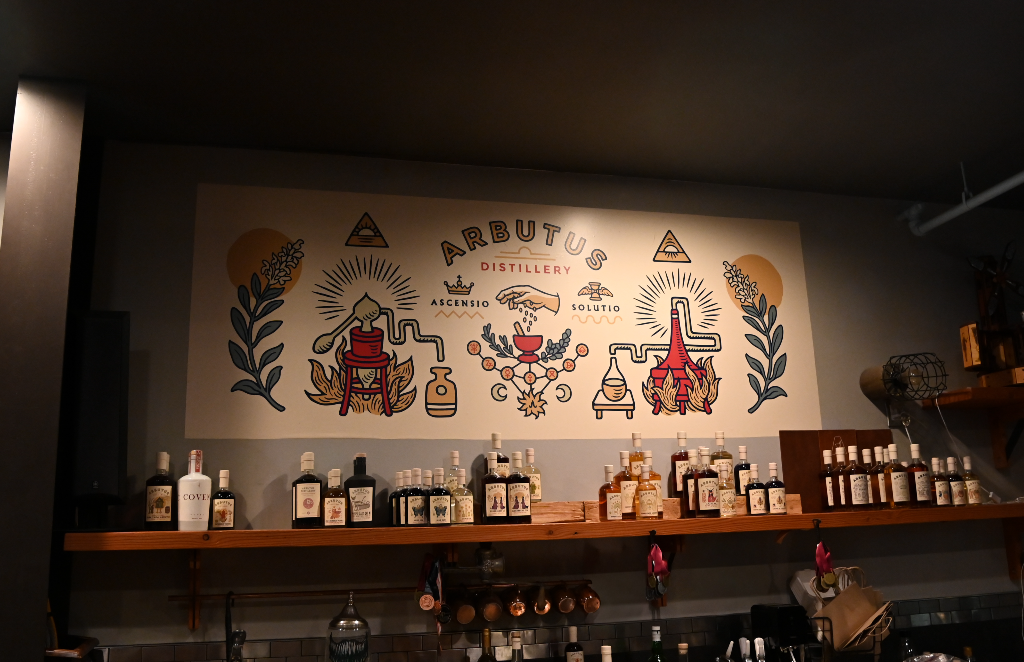
Artwork behind the Arbutus Distilling bar featuring the “Ascensio Solutio” tagline.
What were the first spirits you made?
It started with gin, and then the absinthe. I like interesting gins and making gin in general, because you can do so much with it. The only requirement for a spirit to be called gin is to have mostly juniper. Aside from that, you can add whatever botanicals you want to the ingredient list. You get creative license.
Botanicals play a big role in gin and spirit-making. How do you find the right flavours and combinations?
You have to have a good sense of botanicals, which develops over time. They all distill out differently. Sometimes you think something sounds like a good idea on paper, and once you try it, it’s a no. So, it’s a lot of trial and error and experimentation at the end of the day, and over time, a level of experience develops.
How do you experiment with flavours or techniques without the risk of ruining a full batch?
I often use microstills, or tiny laboratory stills and run ‘mini’ distillations to test an idea before moving things to a larger batch. That gives a rough idea of what each botanical or combination is doing. Once there’s been enough testing and it’s ready to go into production, I’ll often only do a smaller batch for the first one. From there, if it goes well, it’ll get scaled up.
At this point, it's been 12 years of playing around with different botanicals and techniques, so there’s usually an idea of what to expect before testing.
When did you start making whisky?
It was a couple of years after opening before really putting down whisky in any quantity. It would’ve been nicer to put down as much as possible right away, but at that point, I needed to sell stuff to have the funds to barrel whisky.
So, it didn't happen right away. It was a year or two in before really being able to build it into the production schedule.
Are you happy with where the whisky program is currently? Would you like to do more?
There isn’t really any spirit that we make that I like doing more than others. I’m quite happy with where the program is going and with what’s already aging for future release. At the same time, Arbutus isn’t about one spirit type over others. I definitely love whisky, but I also like making absinthe and gin. To me, they're just as interesting. From a day-to-day perspective, I like the variety in making lots of different spirits as well as I can.
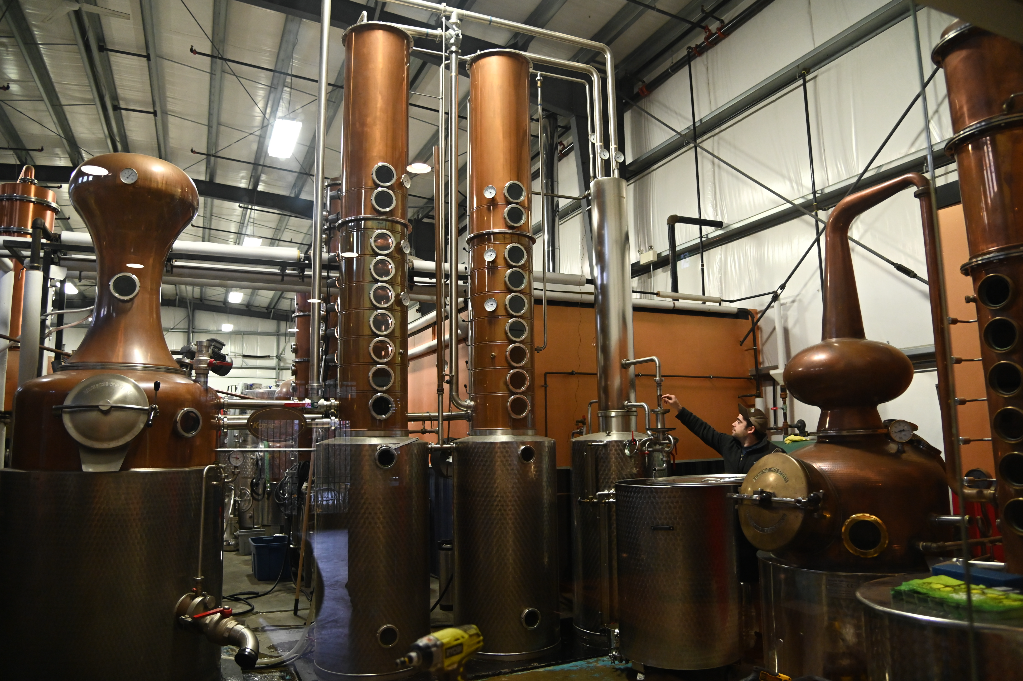
Mike tending to some of the regular-sized stills.
Were there hesitations going into this?
When the business started, the hesitations were more about supply chains. BC craft distillers have to use 100% BC-grown fermentables to keep their designation. At that time, it wasn't like you could just call up traditional suppliers; you had to make sure it was grown here, and that wasn't that common at the time, which made things tricky to work with.
Other than that, I was too young and naive to know what I was getting into. It turned out to be a crazy amount of work.
Is it easier to source ingredients now than when you started?
The supply chain now is pretty good. You have lots of options. A lot of the local farming and agricultural sectors have developed supply specifically for the distillers within the province, so that stuff's great now and getting better.
What was the biggest learning curve when starting Arbutus?
Learning to run a business was kind of crazy. Learning to run a distillery as a business adds another layer of complication. I call it ‘Liquorland’, but ‘Liquorland’ is a weird, strange world where there are rules about everything, and there's reporting about everything in addition to standard business stuff. So the biggest learning curve was all the paperwork and various requirements.
What determines your “craft” status? Is it volume produced per year?
To be a BC craft distillery, everything must be made from 100% BC fermentables, but yes, there is also a production cap. That's where it gets into conversations of like, “Why don’t you sell to other provinces?” It's this dynamic thing where you don't want to jeopardize your craft status here because you sold somewhere else.
Do you think the industry has gotten better over the years? Have the rules relaxed?
It hasn't changed much in terms of the rules; they're pretty much the same as when we started. The industry itself has grown within those rules. If they changed certain things, then there's lots of opportunity for craft distilling to also grow with those changes.
Craft distilling is still the newest of the local producers. Wineries have been around for decades, craft breweries came a couple of decades ago, and then they grew, and as they did, the government realized, “Oh, there's economic opportunity here if we let them grow.” And [craft distilling] is just now in this spot where some of those conversations are starting to happen.
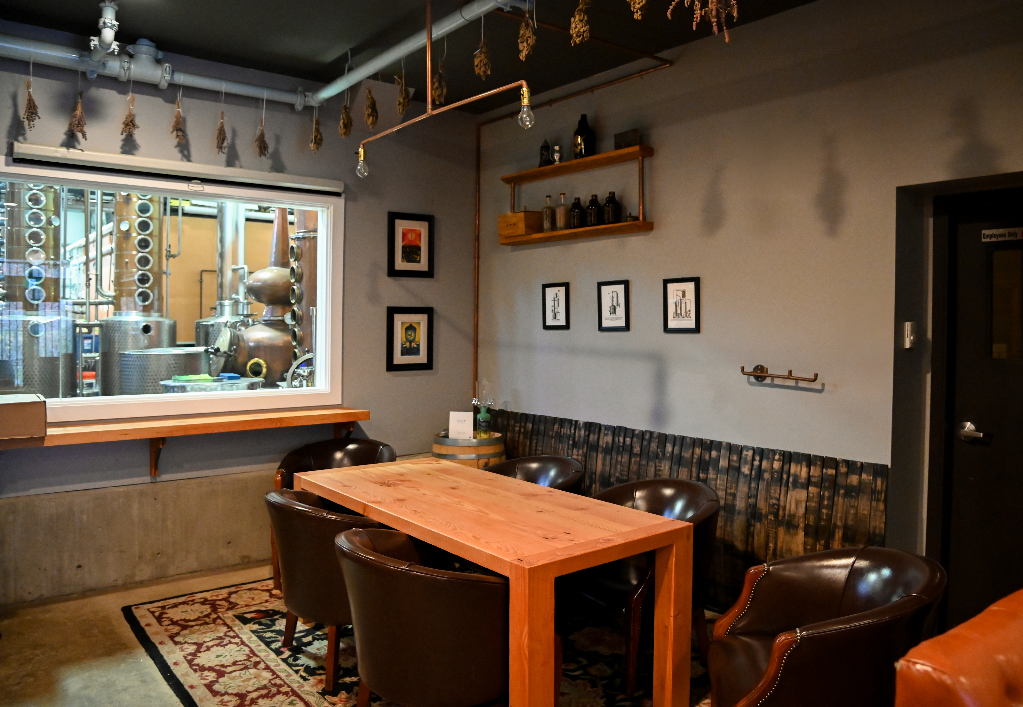
A corner of the cocktail lounge, looking into the distillery.
Do you find that there's more of a community now?
Yes, there's collaboration and community in the sense that you often talk to each other about techniques and share advice on what pitfalls to avoid. There are a lot of people doing super interesting things in weird pockets throughout the Island and the province. [Distilleries] are literally everywhere now; almost every town has one.
Are there some things that you wish people knew about the distilling process or just spirit-making in general?
In general, I’m often surprised by how much people already know about spirits. Maybe it's following the same path as craft beer, where, because they’re exposed to it more now, there’s more general knowledge about it. People find things - whether it's from Arbutus or another distillery - that they like, and then that gets them into it.
What are some of the most common questions people have when they come in?
“What do I do with this?” That's actually the most common question, hands down. They might sip the spirit neat, and they're like, “Oh, I like that,” but that’s often followed by questions about
“What do I pair or do with this?”
That's part of the reason we started doing cocktails: to provide examples. With the exception of whiskies and aged spirits, most spirits will be mixed, so we try to provide some suggestions around that when people come in for tastings.
If you had to choose a product to share with someone completely unfamiliar with the brand and the spirit world in general, what would be your pick?
The Amaro Number 4. I think that one's a great one, because most people like it, but they have no idea what it is at first. “Amaro” means bitter in Italian, so it's a selection of bittering herbs, with plenty of orange peel. It's actually quite sweet, and the bitter comes on the back end of the palate. You can have it neat or just with soda, but it is used heavily as a primary spirit in cocktails. Most people quite like it, but they may have never been exposed to it before.
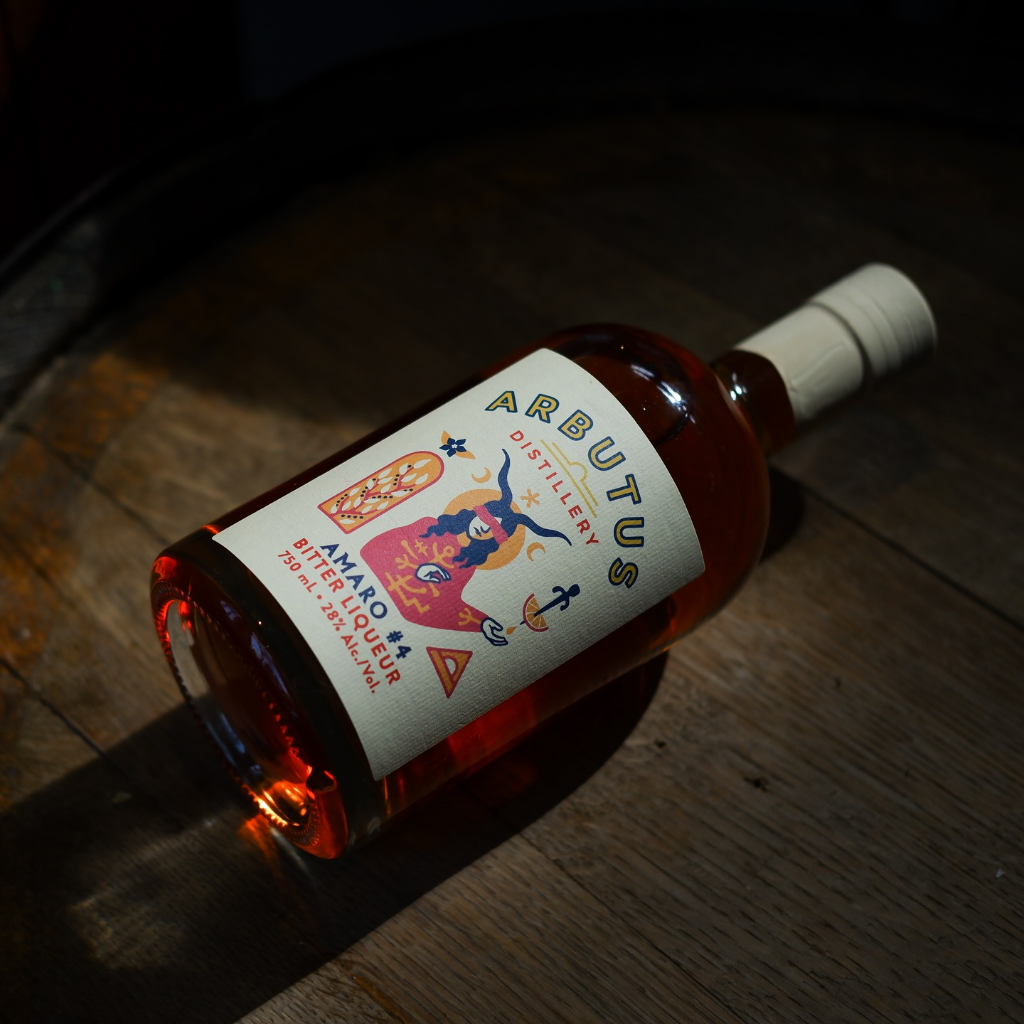
The beloved Amaro #4. Image Credit: Arbutus Distillery Facebook
Are there things that you've tried that maybe just didn't work out the first time, or seasonal/discontinued products, that you'd want to try again?
There have been fails that have never seen the light of day, but as for discontinued products, we used to make this birch liqueur and people really liked it. I still get the odd request for it. It was really interesting flavour-wise and was actually made from birch tree syrup, which is made in a similar way to maple syrup. The farm that we were getting the birch syrup from had a bad weather year, so we couldn't source it for a bit. That's one that maybe we should bring back.
Are there things that you haven't tried that you'd really like to? Certain ingredients or certain styles of spirits that you just haven't had a chance to yet?
I've been working on a chartreuse-like spirit. It's a type of herbal liqueur, and it’s based on distilling a brandy distillate as the spirit’s base. That should be out soon.
I’ve wanted to do one for years. I don't know how well it’ll sell, but that kind of stuff's just fun for me to make, and I really enjoy the process.
Do you export outside of Canada or to other provinces?
Yes, from time to time we’ve exported. We've done France, and we did Taiwan for a little bit there.
We’ve done other provinces. Canada is strange because every province has a completely different tax and distribution structure. But for the most part, BC is where our spirits are sold
Are you at a size that you’re happy with? Are you looking to grow a lot more?
I'm happy with it. I don’t really have dreams of getting any bigger. Things are already quite a lot of work. Getting bigger also comes with more complications.
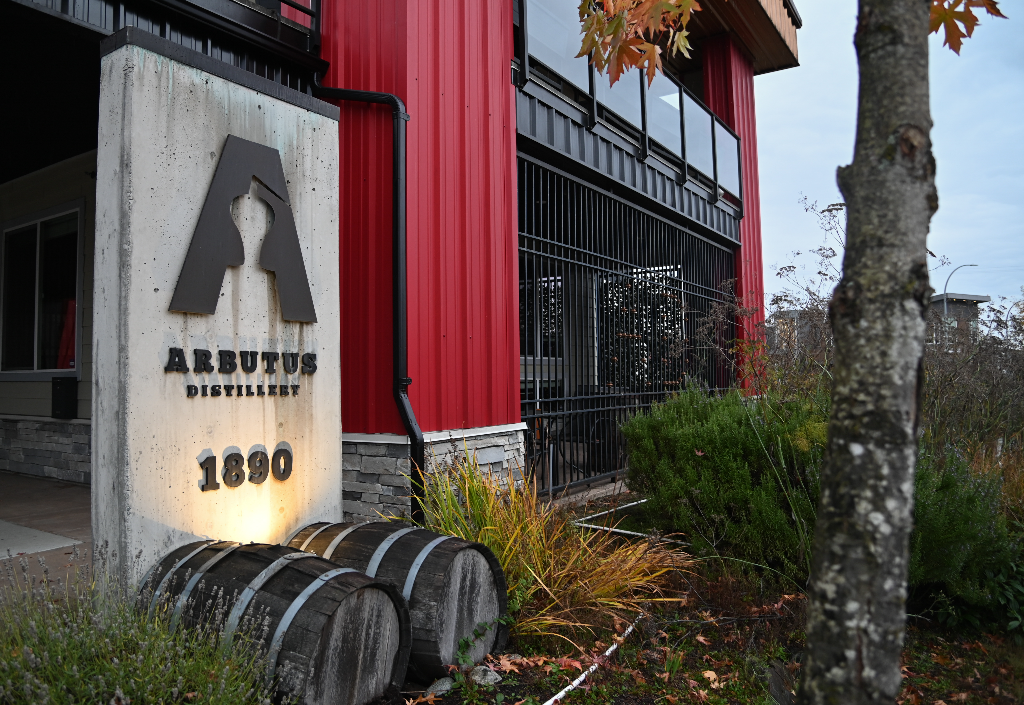
Exterior of Arbutus Distillery & Cocktail Lounge.
Can you talk about what's next for Arbutus? Anything you can share that you're working on?
The herbal liqueur is the one that will come out fairly soon. That's what I'm most excited about. There are lots of different whiskies that are back there (in the barrel house) that will come out over the next couple of years. A new whisky that’s a blend of rye, wheat and barley also comes out soon.
In general, if there's something I find interesting and inspiring to pursue, then I’ll do that.
What is the number one reason you think someone should try Arbutus?
We do a wide range of spirits, so there's probably something that you’ll enjoy.
-------------------------------------------------------------------------------------------------------------------------------
Arbutus Distillery & Cocktail Lounge is located at 1890 Boxwood Rd in Nanaimo. Visit their website for current lounge hours.
A selection of Arbutus products can be found at Mid Island Liquor locations across the Island.
Learn more:
Website: https://arbutusdistillery.com/
Facebook: https://www.facebook.com/arbutusdistillery
Instagram: https://www.instagram.com/arbutusdistillery/
